


*spoiler warning for the movie*
Nimona is a story of two misfits. The titular character Nimona is a shapeshifting rebel with a tragic history of rejection. Ballister Boldheart (Blackheart in the graphic novel) is a newly knighted commoner (unheard of in this futuristic-medieval world) framed for killing the queen. Longing for a friend and itching for mayhem, Nimona searches out Boldheart to become his sidekick. She soon realizes Boldheart isn’t the villainous “Queen Killer” he’s been made out to be. Reluctantly, Boldheart accepts Nimona’s (often destructive) help and together they attempt to clear Boldheart’s name and bring down the corrupt Institute that views differences as monstrous.
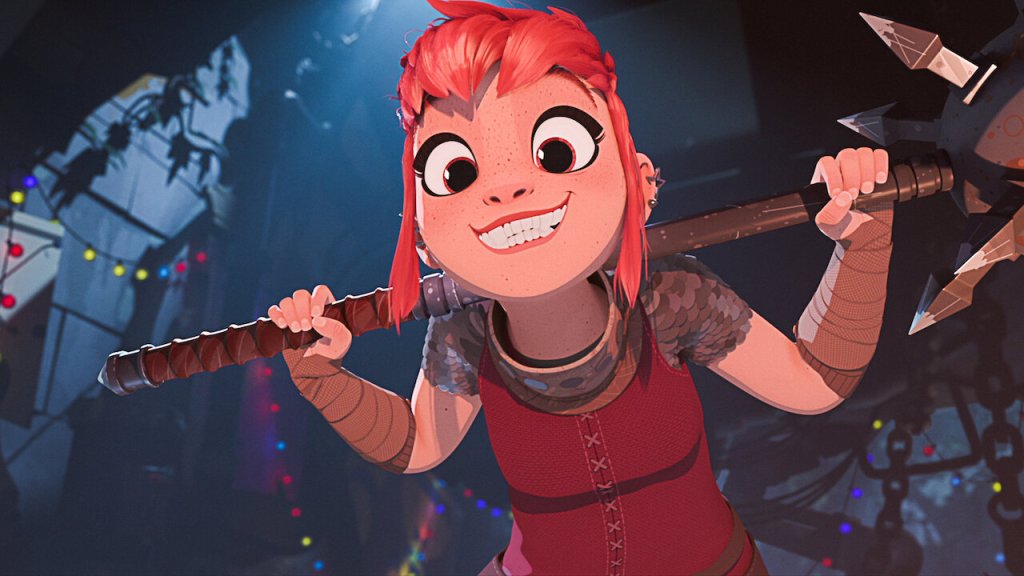
There is a scene in the movie where Ballister Boldheart is treating Nimona’s wounds and they finally have a ‘heart-to-heart’ conversation:
Ballister: “What if you held it in? If you didn’t shape-shift?”
Nimona: “I’d die.”
Ballister: “Good Gloreth! That’s horrible!”
Nimona: “Don’t be so gullible, I wouldn’t die die…I just sure wouldn’t be living.”
To this autistic who had been hiding their true self for two decades, this scene hit me like an arrow through the heart. Most of my formative years were spent masking, mimicking, and hiding as a means of survival. A lot of the abuse I suffered in elementary school and jr. high school was because of my autistic traits. Except because I wasn’t diagnosed these kids and adults abused me because I was “weird”, “difficult”, or “a picky eater”(ARFID). Or because I was “talkative” or I “threw violent tantrums” (meltdowns) etc. etc. So when Nimona explained to Ballister that without shape-shifting she wouldn’t really be living? I realized that I wasn’t really living at all. My mask had prevented me from being who I truly was. Now, being in an encouraging and loving environment my mask is cracking. It’s cracking because I don’t need it anymore. At least not most of it.
*spoiler alert for the film in the next paragraph(s)*
In the most climactic part of the movie Nimona, feeling betrayed by Ballister and hunted by the knights, decides she is going to take her own life. As her emotions boil over into a massive smokey monster billowing around her, she marches towards The City howling in pain. But at the last second, before she impales her heart on the sword of the massive statue of Gloreth in the center of The City, Ballister appears. He apologizes. He’s sorry for ever believing she could be the monster everyone feared her to be. He sees her and doesn’t flinch away. Nimona then collapses into his arms, returning to her human form. This scene also got to me. I too have thought ending it all would relieve me of my pain. But just like Nimona, I have people to pull me back to center. People who stand by my side, unflinchingly.
And I don’t know if Nimona was intentionally autistic-coded or not, but the fact is, as an autistic person I can relate to her. I can find parallels between her story and mine. I know the deep ache of isolation as Nimona does. And I also know the warmth of a hug from those who love me unconditionally, as Nimona does. All in all, Nimona is a must-watch for any autistic, as well as the people they love. It forces us to see that the institutions that govern our society and minds are wrong. Diversity is a wonderful thing and Nimona is a reminder that being different doesn’t automatically make you a monster. It’s those who suppress creativity, originality, and diversity and those that shun, or worse, hurt those perceived as different that are the true monsters.

 The Chronic Typist
I really loved Nimona! Especially when she turned into the giant pink rhino ❤
LikeLiked by 1 person